What happens when a single person with the right AI agent stack can do work that used to require a small team? It is no longer a hypothetical. Carta, which manages cap tables for tens of thousands of startups, reports in its Founder Ownership Report that the share of new startups with a single founder rose from 23.7% in 2019 to 36.3% in the first half of 2025 — and among bootstrapped startups, 38% now have solo founders. AI sits near the center of that shift. As someone who runs an AI-automated, one-person web and e-commerce operation, the gap between 2024 and 2026 is real: tasks that used to eat whole days now run in the background. You still need judgment, but you no longer need a co-founder, a marketing team, and a dev shop just to get started.

In This Article
- 1. What the Founder Data Actually Shows
- 2. Agents vs. Assistants, and the Protocol That Connects Them
- 3. Building Your Solo Founder AI Agent Stack
- 4. Cost Breakdown: Tools vs. a Team
- 5. Real Solo-Founded Products That Worked
- 6. The Honest Limits of an AI Agent Stack
- 7. What I’ve Learned Running Agents on Real Shipments
- 8. How to Build the Stack Without Overdoing It
- 9. Frequently Asked Questions
What the Founder Data Actually Shows
The clearest dataset on this comes from Carta. In its Solo Founders Report, the company found that solo-founded startups climbed from 23.7% of new registrations in 2019 to 36.3% in the first half of 2025 — and that the trend is strongest among bootstrapped companies, where 38% have a single founder versus only 17% of venture-backed ones. The proportion of new startups with solo founders has roughly doubled over the past decade.
This is not just a registration blip. Carta’s analysts explicitly tie the shift to AI expanding what one person can accomplish in a fixed amount of time, which makes it feasible for a single founder to both build and sell. The old playbook — find a co-founder, raise a seed round, hire quickly — is being rewritten for a meaningful slice of new companies.
The broader backdrop reinforces it. Non-employer businesses — companies with no paid employees — already number in the tens of millions in the U.S. and generate well over a trillion dollars in combined revenue. The infrastructure for one-person operations existed before AI. What AI changed is the ceiling: it moved many solo businesses from “survivable” to “genuinely scalable.”

Agents vs. Assistants, and the Protocol That Connects Them
It helps to be precise about the word “agent,” because it gets used loosely. An AI assistant, such as ChatGPT or Claude in a chat window, is reactive: you ask, it answers, then it waits. An agent can plan the steps toward a goal, act on them (send the email, update the record, schedule the follow-up), and adjust based on results instead of waiting for each instruction. An assistant saves time on individual tasks; an agent takes a whole workflow off your plate.
One reason agents became practical for solo operators is the Model Context Protocol (MCP), a connection standard Anthropic introduced in late 2024 and that OpenAI, Google, and Microsoft adopted through 2025. Before it, connecting an agent to your calendar, your store, and your CRM meant three separate custom integrations. With MCP, an agent can reach any tool that supports the protocol, so you can increasingly wire agents into the tools you already use without hiring a developer.
Building Your Solo Founder AI Agent Stack
A working AI agent stack is not one tool. It is a layered system where each agent handles a specific business function — the way you would assign tasks to different roles. The difference is that these agents do not need onboarding and cost a fraction of a hire. Here is a representative layout:
Code and product: tools like Cursor, Claude Code, Replit Agent, or Bolt.new let you describe features in plain language and get working code. For a solo founder shipping a SaaS product, this absorbs a large part of what a contract developer would otherwise do early on.
Marketing and content: a strong general model handles first drafts of posts, email sequences, and ad copy. Paired with a scheduler, that is a content pipeline that runs continuously — though it still needs a human edit pass before anything ships.
Customer support: an AI chatbot trained on your docs can resolve a large share of routine tickets (shipping, returns, basic product questions), escalating the edge cases to you.
Data and analytics: tools that let you ask questions of your numbers in plain language can produce forecasts, churn views, and cohort breakdowns without a dedicated analyst.
Operations and workflow: platforms like Make, n8n, or Zapier connect everything — a new signup updates the CRM, fires a welcome email, and notifies you, with no manual step. The workflow automation market reflects how widely this is being adopted: across major research forecasts it is projected to reach roughly $78 billion by 2030, growing at over 20% annually.

Cost Breakdown: Tools vs. a Team
The cost argument is what makes this hard to ignore. A traditional early-stage team — say two developers, a marketer, a support person, and a part-time analyst — easily runs into the tens of thousands of dollars per month in salaries alone, before benefits or overhead. Exact figures vary by market, but the order of magnitude is not controversial.
The AI alternative is dramatically cheaper: a writing-and-coding model subscription at around $20/month, an automation platform from roughly $10–100/month depending on volume, a support chatbot, hosting, and analytics. Most solo operators can assemble a capable stack for a few hundred dollars a month. That is not a like-for-like replacement — a senior engineer’s architectural judgment and a great marketer’s brand intuition are not things you buy at $20/month. But for a large share of early-stage execution work, the stack gets it done and buys you the runway to find product-market fit, which is the whole game.
Real Solo-Founded Products That Worked
The clearest verified example is Base44. Maor Shlomo built the AI app builder largely as a solo project and, per TechCrunch, sold it to Wix for about $80 million in cash roughly six months after launch, on around $3.5 million in annual recurring revenue. An important nuance: Shlomo was the sole owner but not literally a one-person company — he had about eight employees by the time of the sale. The point is that a single owner, using AI heavily and keeping the operation small, reached an eight-figure exit without venture funding.
Other solo-founded AI products show the same pattern at smaller scale. Danny Postma grew the chatbot tool Chatbase to roughly $50,000 MRR through short-form social content, and Damon Chen — a former Cisco engineer — grew PDF.ai to around $25,000 MRR primarily through SEO and a strong domain. None of these required a traditional team to reach meaningful revenue. What they required was a focused problem, a clear customer, and a distribution channel that fit.
The honest framing matters here. These are real, but they are the visible successes; most solo attempts do not reach these numbers. The lesson is not “you will exit for millions,” it is “a single operator with the right stack can now reach revenue that previously required a team.”
The Honest Limits of an AI Agent Stack
This setup has real downsides, and ignoring them leads to expensive mistakes.
Expertise gaps are real. AI can write code without telling you whether the architecture will scale, and it can draft a contract that still needs a lawyer. When an agent produces something confidently wrong and you lack the domain knowledge to catch it, that is a genuine risk. You are, to some degree, trusting that the output is good — which is exactly why high-stakes outputs need human review.
Compute costs can spiral. If you run heavy workloads — large datasets, many simultaneous agents, model-heavy core features — costs can jump from hundreds to far more per month. The lean budget assumes you are using AI as a tool, not building AI as your core product.
Burnout is the hidden tax. When you are the only human in the loop, every decision lands on you. AI handles execution, but strategy, customer relationships, and crisis management still require your attention, and there is no one to share the cognitive load. Fewer total hours can still feel more draining when every hour is high-stakes.
Scalability has a ceiling. A solo founder with AI agents can plausibly build a company to a few million in revenue. Beyond that, you will usually need people — for enterprise sales, key relationships, or specialized expertise AI cannot fake. The stack is a launchpad, not necessarily a permanent structure.

A few more places where a lean stack reliably breaks down:
- Relationship judgment. AI can draft a logically optimal reply to a sensitive request while missing the relationship history that should shape it. High-stakes relationship calls need your read, not the model’s.
- Voice drift in serial content. A model writes one strong post, but across a long sequence the voice shifts. Review a series as a series, not piece by piece.
- Crisis prioritization. When several urgent threads land at once, AI can draft each message, but deciding who to reach first and what tone each needs is still your job.
- Physical-world checks. AI can’t inspect a sample for defects. Any business with physical products keeps human touchpoints that no stack replaces.
What I’ve Learned Running Agents on Real Shipments
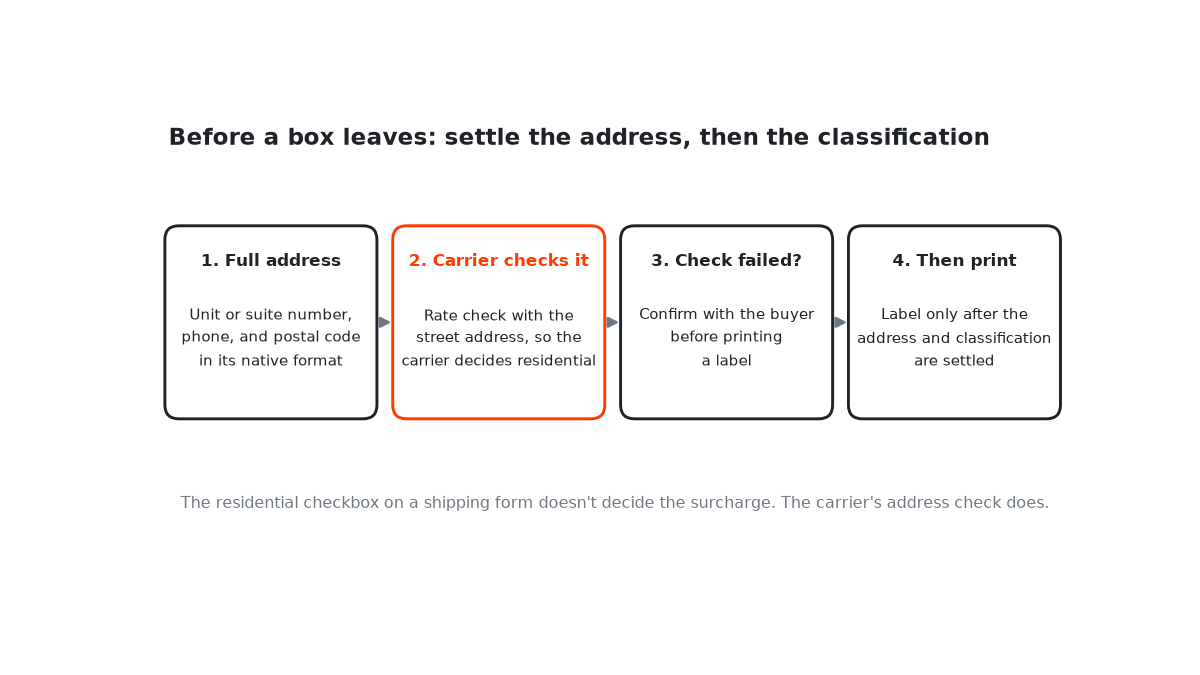
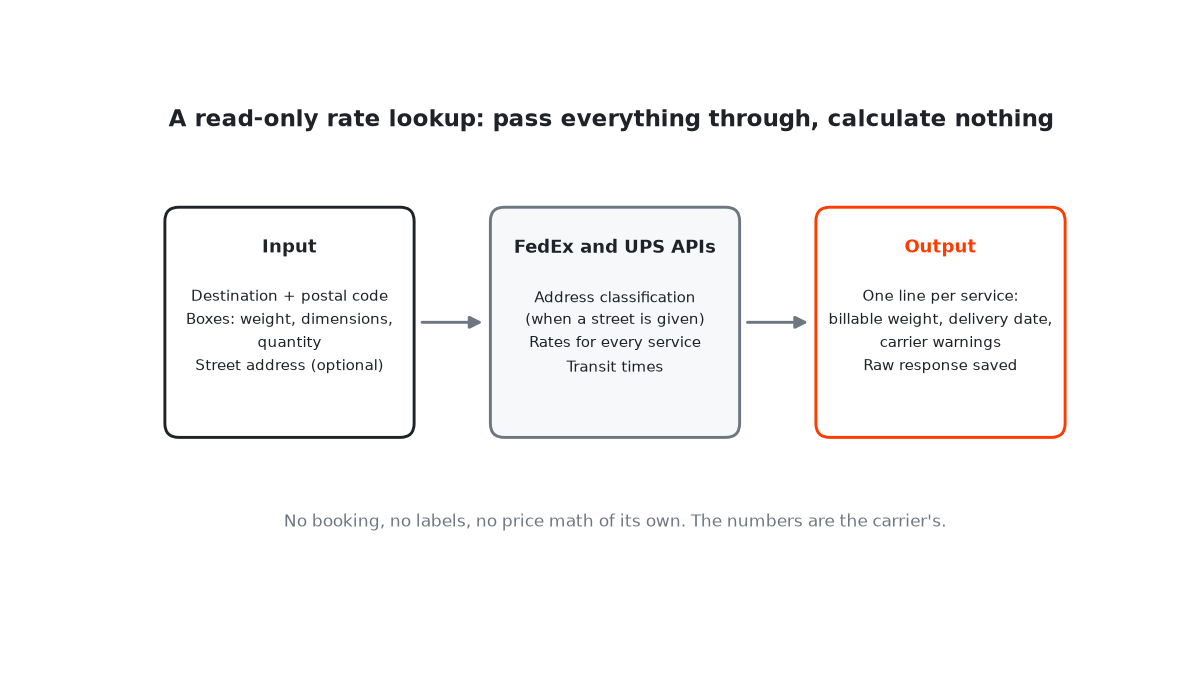
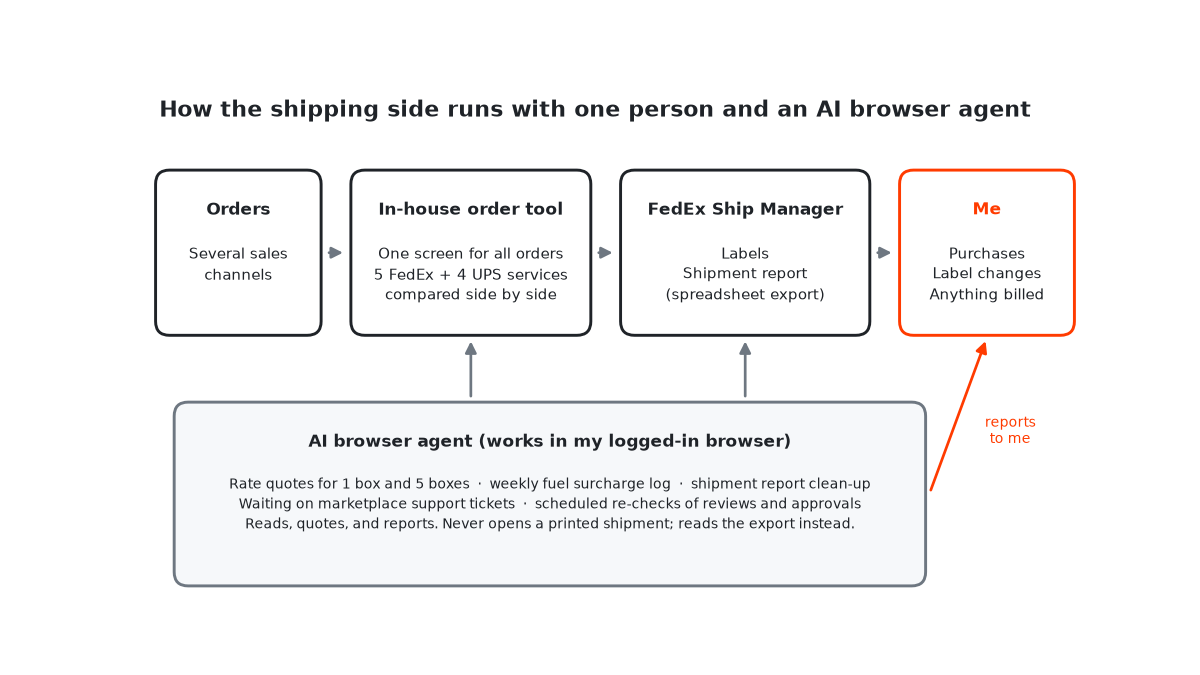
One agent workflow I rely on is international shipping rate checks. I ship mostly in 22kg boxes, so each check covers one box and five boxes (110kg) at once (the full setup is here).
The lesson that workflow taught me is to check the inputs before trusting the output. During one long session my FedEx login expired quietly. The rate page kept answering, but with logged-out public prices instead of the prices for my account, and there was no error. The fix is simple: confirm the session before trusting any number it produces.
The general rule I’d keep: start with one repetitive task where a wrong answer is cheap to catch, and make the agent prove its inputs before you act on its output.
How to Build the Stack Without Overdoing It
The most reliable way to avoid the traps above is to design your stack around one revenue path first. Pick the path that starts with lead capture and ends with a paid invoice, then map every handoff in between: research, outreach, qualification, proposal, fulfillment, support, and renewal. Do not automate all of it on day one. Pick the noisiest handoff and build one small agent around that single point. For many solo founders, that is inbox triage or proposal drafting, because both steal attention without directly creating strategy.
Here is a useful test before adding any agent: can you describe the input, the decision rule, the output, and the failure mode in plain English? If you cannot, the workflow is not ready to automate. A research agent can gather competitor pricing and summarize it. A support agent can draft replies from a knowledge base. A finance agent can flag unpaid invoices. But none of those should silently change prices, promise custom terms, or send refunds without a human checkpoint.
The best solo stacks feel less like a robot team and more like a checklist that talks back. Each agent owns a narrow lane, each lane has a review point, and each review point produces a clear next action. A practical starting set is three agents: one that gathers market context, one that turns notes into checklists, and one that drafts customer replies without sending them automatically. That trio supports sales, delivery, and retention without pretending to replace judgment. Once those lanes work reliably, you can add analytics, bookkeeping, or content support.
The final rule is simple: automate the repeatable part, keep ownership of the risky part. Pricing, positioning, refunds, legal commitments, and hiring still need a person. AI agents make the solo model more powerful when they protect your attention rather than hide important decisions from you — and small, visible controls beat invisible complexity every time, especially when the business gets busy and sloppy automation tends to break.
Frequently Asked Questions
Can a non-technical person build an AI agent stack?
Largely, yes. Tools like Replit Agent, Bolt.new, and Lovable are designed for people who do not write traditional code — you describe what you want and the AI generates it. You will still want technical help as you grow, but the barrier to a first working version has never been lower.
How much does a solo founder AI agent stack cost per month?
For most solo operators, a few hundred dollars a month covers a coding-and-writing model (~$20), automation ($10–100 depending on volume), a support chatbot, hosting, and analytics. Exact totals depend on usage, since several of these tools meter by consumption.
What are the biggest risks of running a business on AI agents?
Three stand out: expertise gaps (confident but wrong outputs), founder burnout (every decision still lands on you), and a scalability ceiling (you will likely need people beyond a few million in revenue). Always review AI outputs where mistakes carry financial or legal consequences.
Will AI agents fully replace startup teams?
Not fully. Agents handle execution tasks — coding, writing, analysis, routine support — extremely well. Strategy, relationship building, and deep domain expertise still need human judgment. The realistic sweet spot is using agents to handle execution while you make the decisions only a founder can make.
Is the solo founder trend sustainable or just a bubble?
The Carta data points to a multi-year structural trend rather than a spike, and the underlying enablers — cheaper tooling, capable models, and a large, growing automation market — are not going away. That suggests durability, though it does not guarantee any individual business will succeed.
The Bottom Line for Solo Founders
The solo founder AI agent stack is a present reality, backed by founder-ownership data, verified product stories, and straightforward economics. A single operator can now do the work that recently required several roles, for a fraction of the cost. Base44 showed an eight-figure exit is possible from a solo-owned, AI-heavy build; smaller products show the same pattern at smaller scale.
That does not make it easy. You still need domain knowledge, strategic clarity, and the discipline to review AI outputs carefully — the tools amplify your direction, good or bad. But the barriers that once required teams, funding, and years of runway are genuinely lower. Build your stack around one revenue path, keep a human on the risky decisions, and ship.
Keep Reading
- The One-Person Company Idea, Examined Honestly
- Vibe Coding for Micro-SaaS
- Karpathy, Anthropic, and the Solo Claude Workflow